
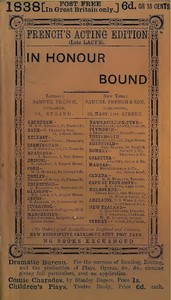
In Honour Bound: An Original Play, in One Act. by Sydney Grundy
If you think Victorian plays are all long-winded and stuffy, Sydney Grundy's In Honour Bound might change your mind. This one-act play is a tightly wound spring of drama, set entirely in a drawing-room on a wedding day.
The Story
Lady Alethea is hours away from marrying the wealthy Lord Marchmont. It's not a love match; she's doing it to rescue her brother from financial disaster. Her family's honor, and their future, depends on this sacrifice. But as she's steeling herself for the ceremony, Sir George Ormond arrives. He's the man she truly loves and was compelled to refuse. Suddenly, the room that felt like a stage for duty becomes a prison. George pleads with her, asking if she can truly go through with a marriage built on a transaction. The entire play is this charged conversation—a battle between passionate love and cold, rigid duty. The clock is ticking, the wedding guests are waiting, and Alethea has to decide what 'honour' really means.
Why You Should Read It
What grabbed me was how immediate it feels. Grundy strips away all the extras and puts two people in a room with an impossible problem. You feel Alethea's agony. Is honoring her family's name worth sacrificing her own happiness and integrity? Is George's love selfish, or is he the only one seeing the truth? The play doesn't give easy answers, which makes it so compelling. It's less about the plot and more about the weight of that single, life-altering choice. The dialogue crackles with suppressed emotion—it's formal on the surface, but you can feel the desperation underneath every polite word.
Final Verdict
This is a perfect pick for anyone who loves character-driven drama or is curious about Victorian theatre beyond the big names like Wilde or Shaw. It's also ideal if you're short on time but want a story that sticks with you. You can read it in one sitting, but you'll think about Alethea's dilemma for much longer. If you've ever felt torn between what you want and what you're 'supposed' to do, this 19th-century play will speak directly to you.
This work has been identified as being free of known copyright restrictions. It is available for public use and education.
Joseph Smith
1 month agoThe peer-reviewed feel of this content gives me great confidence.
Nancy Jones
8 months agoAfter a thorough walkthrough of the table of contents, the clarity of the writing makes even the most dense sections readable. Thanks for making such a high-quality version available.
Barbara Taylor
1 year agoThis is an essential addition to any academic digital library.
Richard Gonzalez
3 months agoIt took me a while to process the complex ideas here, but the cross-referencing of different chapters makes it a great study tool. The insights gained here are worth every minute of reading.
George Thompson
2 years agoI took detailed notes while reading through the chapters and the structural organization allows for quick referencing of key points. Well worth the time invested in reading it.